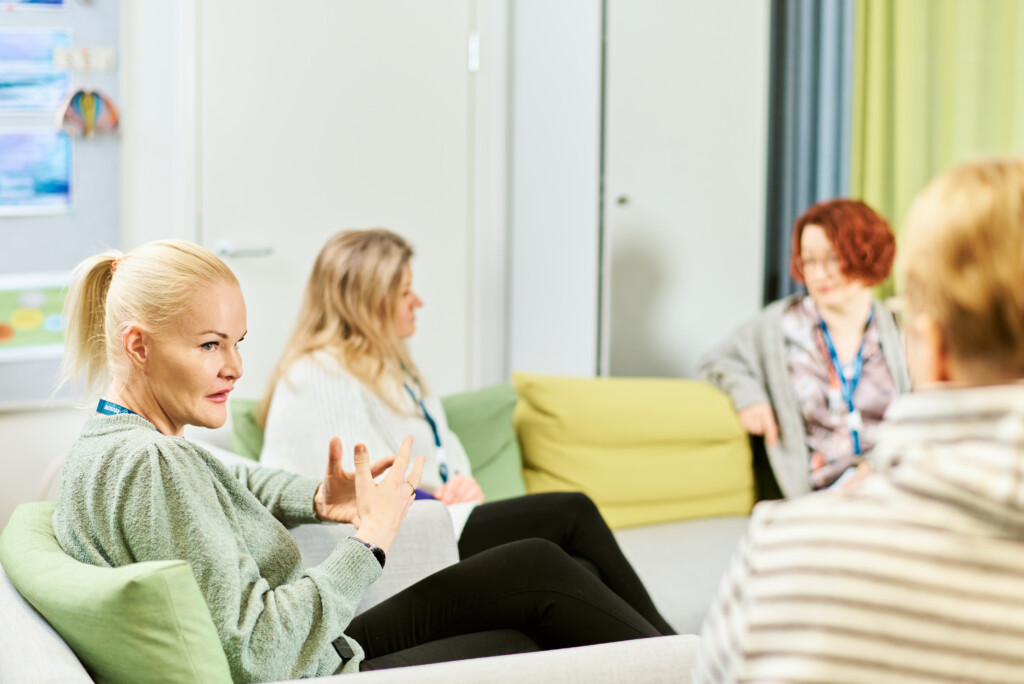

Keusote, the Wellbeing Services County of Central Uusimaa, has joined the CHN ecosystem to strengthen its research, development and innovation activities as well as its collaboration with companies. At Keusote, the move is seen as a natural next step in the region’s long-term development work, which has been built systematically over a number of years.
Keusote serves around 210,000 residents across six municipalities in Central Uusimaa and employs more than 4,000 professionals. The region is characterised by rapid growth, an ageing population, and young people and families moving in from the Helsinki metropolitan area. This creates a strong need for development: services must be renewed in a way that is simultaneously customer-oriented, effective and economically sustainable.
Keusote’s research, development and innovation work has been built by Medical Director, Director of RDI Pirjo Laitinen-Parkkonen together with RDI Manager Hanna Pellikka. They describe Keusote’s RDI unit as small but highly effective. Over the years, the region has built well-functioning development models, an idea pipeline and an overall development framework that make it possible to identify new development areas quickly and take them forward either as rapid experiments or as broader projects.
At Keusote, development work is guided by an emphasis on impact, evidence-based decision-making and a clearly defined RDI programme. Research themes arise from the region’s own needs and relate, for example, to major public health conditions, prevention, client safety and the growing substance abuse challenges faced by young people. Social science research, digitalisation and the evaluation of service effectiveness are also an important part of the whole. The work is supported by a researcher network made up of Keusote’s own employees, strengthening collaboration with partners and bringing a practical perspective to development.
Joining the CHN ecosystem gives Keusote a new way to strengthen, in particular, its collaboration with companies and its expertise related to commercialisation. At Keusote, the organisation is considered to be at the right stage of maturity to take the next step towards closer cooperation with companies and other stakeholders. At the same time, Keusote brings its own strengths to the network: a culture of organised development, a flexible way of working, and readiness to act as an attractive partner for new initiatives.
Keusote also sees considerable potential in CHN collaboration for broader cooperation between wellbeing services counties. Themes of particular interest include digital solutions, artificial intelligence, the harmonisation of information and the usability of data, for example across the Uusimaa region. In the longer term, the aim is to find a balance between locally important development priorities and national priorities, and to turn the collaboration into concrete, high-impact results. At Keusote, there is also a belief that the county’s compact size may offer useful lessons for other wellbeing services counties of a similar size in Finland.